JavaScript vs TypeScript: Which Should Developers Learn in 2026?
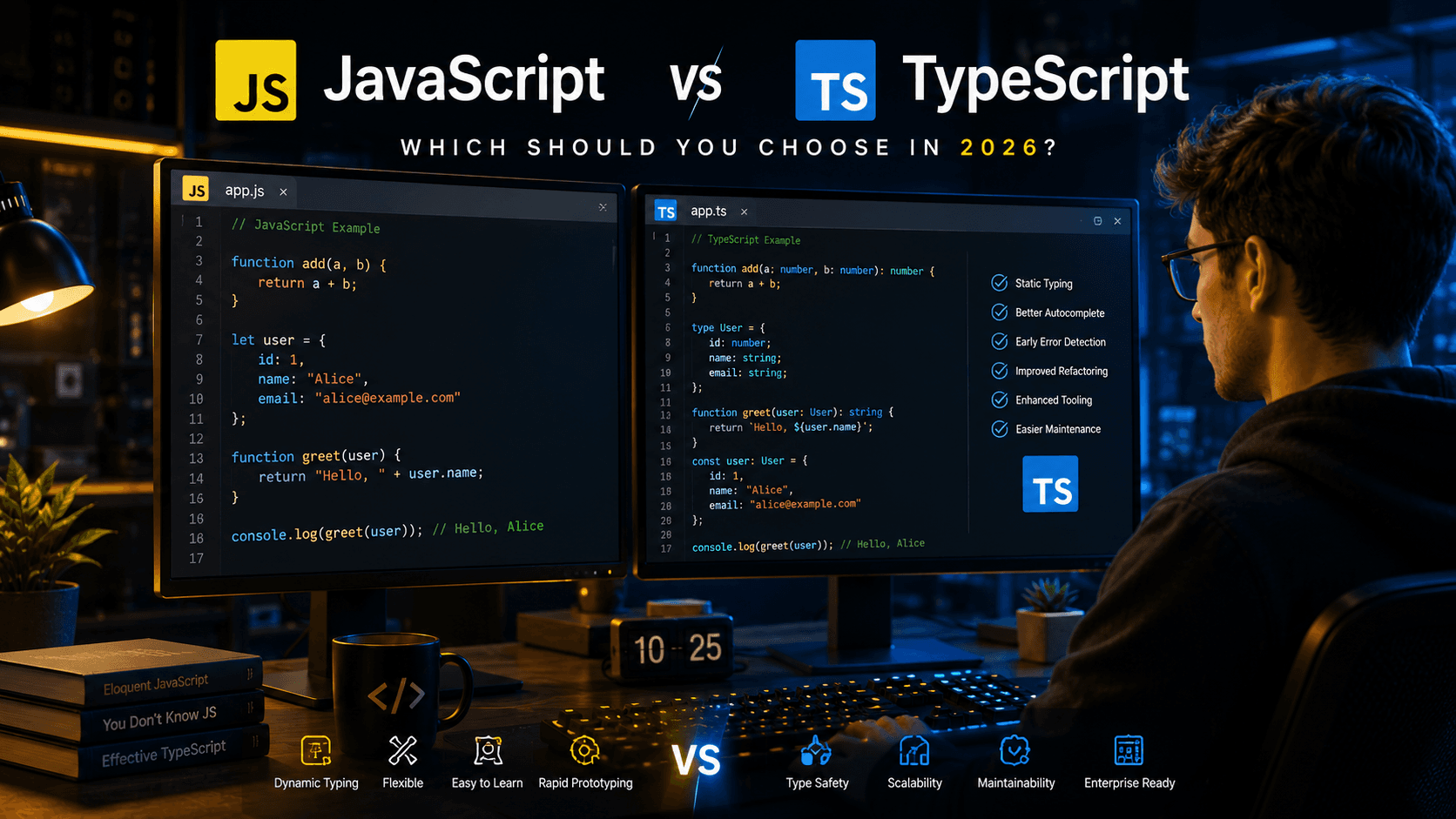
JavaScript or TypeScript? Discover the key differences, benefits, and real-world use cases to decide which language is right for your development career in 2026.
JavaScript has been the foundation of modern web development for decades.
However, in recent years, TypeScript has rapidly gained popularity among professional developers and large engineering teams.
If you're starting a new project or learning web development, you may be wondering:
Should I learn JavaScript or TypeScript?
The answer depends on your goals, project size, and development workflow.
In this guide, we'll compare JavaScript and TypeScript, explore their strengths and weaknesses, and help you decide which language is best for your needs.
What Is JavaScript?
JavaScript is a high-level programming language used to create interactive websites and web applications.
Today, JavaScript powers:
- Websites
- Web applications
- Mobile apps
- Desktop applications
- Backend services
It is supported by all modern browsers and remains one of the most widely used programming languages in the world.
What Is TypeScript?
TypeScript is a superset of JavaScript created by Microsoft.
It adds features such as:
- Static typing
- Interfaces
- Generics
- Better tooling
- Improved maintainability
TypeScript code is eventually compiled into JavaScript before running in the browser or server.
Key Difference Between JavaScript and TypeScript
The biggest difference is typing.
JavaScript:
let age = 25;
age = "twenty-five";
This is valid JavaScript.
TypeScript:
let age: number = 25;
age = "twenty-five";
TypeScript immediately reports an error.
This helps developers catch bugs before deployment.
Why Developers Love TypeScript
Better Error Detection
TypeScript catches many mistakes during development.
Examples include:
- Incorrect data types
- Missing properties
- Invalid function arguments
Improved Developer Experience
Modern editors provide:
- Autocomplete
- Type checking
- Better navigation
- Safer refactoring
Easier Team Collaboration
Large teams benefit from clear type definitions.
Developers can understand code faster without reading every implementation.
Why Developers Still Use JavaScript
Simplicity
JavaScript has less syntax.
Beginners can start quickly.
Faster Learning Curve
Developers don't need to understand advanced type systems immediately.
Universal Support
Every browser runs JavaScript natively.
JavaScript vs TypeScript Comparison
| Feature | JavaScript | TypeScript |
|---|---|---|
| Easy to Learn | ✅ | ⚠️ |
| Type Safety | ❌ | ✅ |
| Tooling | Good | Excellent |
| Scalability | Good | Excellent |
| Error Prevention | Limited | Strong |
| Large Projects | Good | Excellent |
Performance Differences
Many developers assume TypeScript is faster.
In reality:
TypeScript → Compiles → JavaScript
The browser executes JavaScript.
Runtime performance is typically the same.
The main advantage of TypeScript is development-time safety.
TypeScript in Modern Development
Many popular frameworks recommend or default to TypeScript:
- Next.js
- Angular
- NestJS
- Remix
- Astro
Large companies increasingly adopt TypeScript because it improves maintainability.
Which Language Should Beginners Learn?
Many developers ask:
Should I Learn JavaScript First?
Yes.
Understanding JavaScript fundamentals makes learning TypeScript much easier.
Recommended path:
JavaScript
↓
ES6+
↓
React
↓
TypeScript
↓
Next.js
This progression builds a strong foundation.
When to Choose JavaScript
JavaScript is ideal for:
- Small projects
- Learning programming
- Quick prototypes
- Simple websites
When to Choose TypeScript
TypeScript is ideal for:
- Production applications
- Large teams
- Long-term projects
- Enterprise software
Common Mistakes
Skipping JavaScript Fundamentals
Learning TypeScript without understanding JavaScript often creates confusion.
Using Any Everywhere
Many beginners disable TypeScript's benefits by overusing:
any
Overengineering Small Projects
Not every project requires complex type systems.
Career Opportunities
Both JavaScript and TypeScript skills are highly valuable.
However, TypeScript knowledge is increasingly listed as a requirement for:
- React developers
- Next.js developers
- Frontend engineers
- Full-stack developers
Learning both provides the greatest flexibility.
Frequently Asked Questions
Is TypeScript replacing JavaScript?
No.
TypeScript builds on top of JavaScript rather than replacing it.
Should beginners learn TypeScript first?
Most developers benefit from learning JavaScript fundamentals before TypeScript.
Is TypeScript harder to learn?
Slightly.
The type system introduces additional concepts.
Do companies use TypeScript?
Yes.
Many modern engineering teams use TypeScript extensively.
Further Reading
Future Programming Articles:
- Why Developers Love TypeScript
- React vs Vue
- Next.js vs React
- Node.js for Beginners
- Best Backend Languages in 2026
Final Verdict
JavaScript remains one of the most important programming languages in the world and serves as the foundation of modern web development.
TypeScript builds on that foundation by adding powerful tools that improve code quality, maintainability, and developer productivity.
For most developers in 2026, the best approach is simple:
Learn JavaScript first.
Then learn TypeScript.
Together, they form one of the most valuable skill combinations in modern software development.
Related Articles
More from the Programming category

React useState Hook Complete Guide (2026): Syntax, Examples & Best Practices
Learn everything about React's useState Hook, including syntax, real-world examples, updating state correctly, best practices, and common mistakes.
Best Programming Languages to Learn in 2026: Complete Developer Guide
Not sure which programming language to learn in 2026? This guide compares the most in-demand programming languages and helps developers choose the right path.

Data Structures and Algorithms for Beginners: Complete Guide in 2026
Master the fundamentals of Data Structures and Algorithms with this beginner-friendly guide. Learn the concepts every software developer should know.